Tormund
Tormund is a free folk warrior whose fame rests mostly on the stories he tells about himself. Leader of his own war party, he is one of the first faces of the free folk that Jon Snow meets once he crosses beyond the Wall, and from then on his name stays tied to the wildlings looking for a place south of the Night's Watch.
Chapter 1
The feats he tells himself
Tormund insists he never killed a giant: what he actually did was cut open a sleeping giantess and crawl inside her to escape the cold of a winter storm. According to him, the giantess mistook him for a newborn and nursed him through an entire spring, some three months.
He also boasts of having shared a bed, hopelessly drunk, with a bear. Before any of that, he had set his sights on the title of King-Beyond-the-Wall himself, an ambition Mance Rayder crushed by defeating him.
Chapter 2
The leader of the war party
Books and show
 Jon Snow
Tormund stands among the wildlings gathered around Mance Rayder when Jon Snow arrives at the camp; he commands his own war party and is the one who shows Jon the giants marching with the free folk. Curious about his nicknames, Jon guesses that his nickname Horn-blower comes from the Horn of Winter that woke those creatures.
Soon after, Jon joins Tormund's party, along with Ygritte and Ryk, to climb the Wall. Later, after the free folk's first assault on Castle Black, when Jon comes back to parley with Mance, it is Tormund who greets him first and walks him to the king's tent, and who speaks up for his right to be heard.
Chapter 3
The battle of Castle Black
Books and show
 Stannis Baratheon
When Stannis Baratheon charges against the free folk, Tormund puts three lines of spearmen at the front; Stannis's knights hit them from the side and the lines break. Once the fighting ends, the wildlings left scattered across the field begin regrouping around him.
With Mance Rayder taken prisoner after the defeat, it is Tormund who is left in command of what remains of the free folk's army.
Chapter 4
Peace, and Oakshield
Jon sends Val to the wildling camp to offer Tormund a peace deal; Tormund accepts the terms and sets out for the Wall.
His own people dislike the bargain, but the attacks that have been thinning their ranks, and the hardship weighing on the free folk, matter more than pride, and he accepts what the Night's Watch is offering.
As part of the payment he takes off his gold armbands and hands them to Jon, telling him he inherited them from his father, who had inherited them from his own.
Jon warns him the Braavosi will melt them down without a second thought, and that it would be a shame — he should keep them. Tormund won't hear of it: he refuses to let it be said that Tormund Thunderfist made the free folk give up their treasures while holding on to his own.
In return, Jon grants him the castle of Oakshield, for him to settle there with his clan and build his power from it.
Chapter 5
Portrait of a warrior
Tormund has a thick white beard and a broad, ruddy face; he isn't a tall man, but he has a wide chest and an enormous belly.
The nickname Horn-blower was Mance Rayder's doing, who credited him with lungs out of the ordinary. He laughs easily, and likes to say his laughter could sweep the snow off a mountainside; when he raises his voice in anger, it sounds to Jon like the bellow of a mammoth.
He's never far from a horn of mead, so even his threats come out with a sweet aftertaste, and he shakes hands like he means to break your fingers.
He wears a solid gold armband on each arm, carved with the runes of the First Men, as much a part of him as his beard. Good-natured by temperament, there's no feast or mead-horn he doesn't enjoy — though he distrusts the people of the Frozen Shore, and never learned to read.
Gallery
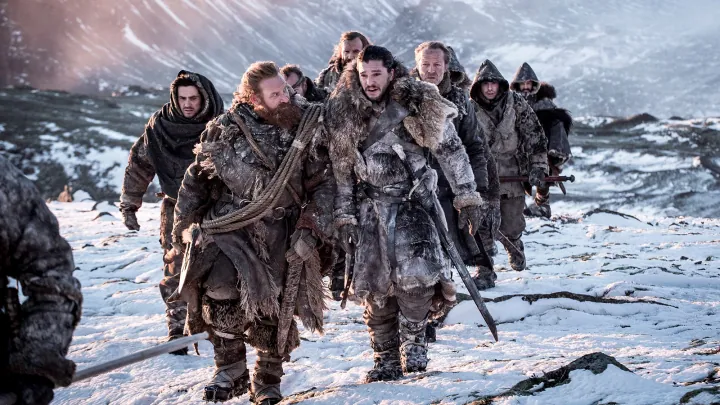
Tormund, image 2706 Tormund Beric Sandor Jon Jorah Gendry.jpg · gameofthrones.fandom.com · this wiki publishes under CC-BY-SA 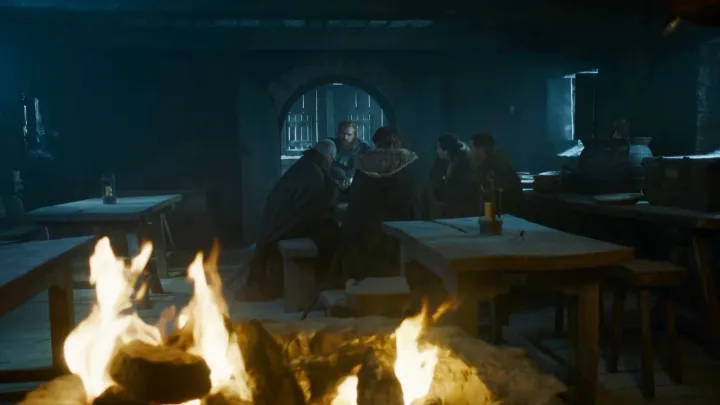
Tormund, image 3705 Eastwatch Meeting Room.png · gameofthrones.fandom.com · this wiki publishes under CC-BY-SA 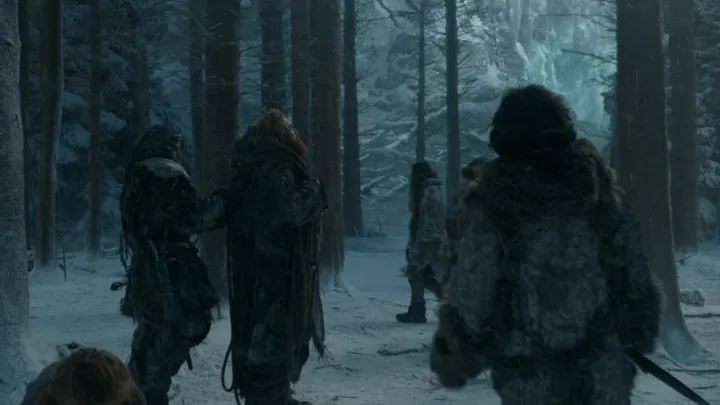
Tormund, image 4306 Tormund north side of the Wall.jpg · gameofthrones.fandom.com · this wiki publishes under CC-BY-SA


