Braavos
Braavos is the largest and richest of the Free Cities, a city of canals and bridges hidden behind a cliff watched over by a stone giant. Unlike the rest of the Free Cities, it was never part of the Valyrian Freehold: it was born when a shipload of slaves rose up against their captors.
Its origin shaped its law: no one in Braavos can be a slave, and its Sealords have fought the slave trade for centuries. In time the city also became home to the most powerful bank in the known world, one that lends money to foreign realms, the Seven Kingdoms among them.
Chapter 1
The bastard son of Valyria
From 500 BCBooks only
Legend has it that around the year 500 before the Conquest, a ship loaded with slaves, prostitutes and thieves bound for a new Valyrian colony in Sothoryos rose up against its captors, seized the vessels, and went looking for a corner of the world where no one would come looking for them. Among the mutineers travelled priestesses from Jogos Nhai known as the moonsingers, who according to legend pointed the way to a refuge: a lagoon hidden behind a wall of stone, wrapped almost always in mist, far from the eyes of dragons. Braavos was born there, and the moonsingers' temple remains the largest in the city today.
The founders included Andals, Summer Islanders, Ghiscari, Naathi, people of the Rhoyne, Ibbenese, Sarnori, and Valyrians fleeing their own debts or crimes. Having risked their lives for freedom, they swore that no one in their city would ever be a slave again: that promise was carved in stone above the Long Canal and became the city's first law.
Braavos's existence stayed secret for a century, and its exact location for three times that long, until an episode remembered as the Unmasking of Uthero brought it to light. That is why it is still called the bastard son of Valyria.
The founding promise did not stay a mere oath: around the year 200 after the Conquest, Braavos forced a treaty on neighbouring Pentos to curb slavery within its streets, and over the centuries the city's Sealords have waged more than one war on slavers and those who shelter them.
Generations later, the same city hid Prince Viserys Targaryen and his younger sister, Princess Daenerys, who grew up there in the care of Ser Willem Darry, in a large house with a red door and a lemon tree in the garden.
Chapter 2
Beyond the Titan
Books only
To reach Braavos a ship must pass between the legs of a colossal statue, the Titan, its eyes ablaze and its green hair streaming in the wind: it is the only way into the lagoon where the city sits. A hidden mechanism inside produces a roar that announces arriving ships and marks daybreak and nightfall.
Inside the lagoon there are no walls: the city occupies a hundred low islets linked by carved stone arches, and along its canals glide narrow boats poled from the stern. The buildings, grey and narrow, end in pointed roofs, and among them rise marble palaces and copper-domed temples.
A great canal leads to the Isle of the Gods, where most of the city's temples cluster; the largest, the Temple of the Moonsingers, is crowned with a silver dome. Near the Purple Harbor and the Moon Pool, where bravos fight their duels, sit the city's best taverns and brothels; in the Ragman's Harbor, poorer and more chaotic, the Common Tongue is easier to hear.
Chapter 3
The bank and the bravos
Books and show
Braavos lives off the sea and off trade: its ships paint their hulls and sails purple and sail as far as Asshai and the islands of the Jade Sea. The city lends money like few others: the Iron Bank of Braavos finances foreign realms, the Seven Kingdoms among them.
Its society is sharply layered: the oldest families dress in dark, understated tones, while the bravos, young swordsmen who fancy themselves masters of the night, favour bright, showy clothes and look for duels at the Moon Pool. The city's great courtesans, meanwhile, hold a social standing granted nowhere else.
Chapter 4
A new face
Books and show
 Arya Stark
Arya Stark arrives in Braavos and enters the House of Black and White, the temple of the Many-Faced God: a windowless building of dark grey stone, its black roof rising to a sharp point. There she begins her training in service to the god who deals out death.
Inside those walls she leaves behind the name and the face she arrived with.
Chapter 5
A stop on the way to Oldtown
Books only
 Samwell Tarly
On the way to Oldtown, Samwell Tarly makes a stop in Braavos together with Maester Aemon, the singer Dareon, and Gilly.
It is the same Braavos where Arya Stark now walks, though their paths never cross: for Sam the city is only a port of call, a brief rest before continuing on to the Citadel.
Chapter 6
The first man
Books only
Arya's training at the House of Black and White continues, in service to the Many-Faced God, until the point where she kills her first man.
It is one more step in a training that goes on, slowly, within those same walls of grey stone.
The physical world
Tras pasar el Titán surge una gran laguna, con una primera isla, el Arsenal, un saliente de rocas que surge de las aguas como un puño con púas, con las almenas rebosantes de escorpiones, escupefuegos y trabuquetes.
Geography · Juego de Tronos, Capítulo 41, Jon.
Hay numerosos palacios, templos y torres.
Geography · Festín de Cuervos, Capítulo 25, Samwell.
La Ciudad Ahogada es una zona de la ciudad inundada, cuyas cúpulas y torres sumergidas sobresalen de las aguas verdes de la albufera. Junto a sus puertas se encuentra la Cripta Moteada, donde hay peleas de anguilas.
Geography · Festín de Cuervos, Capítulo 22, Arya.
Es una de las zonas favoritas de los jaques para batirse en duelo.
Geography · Festín de Cuervos, Capítulo 34, Gata de los Canales.
Gallery
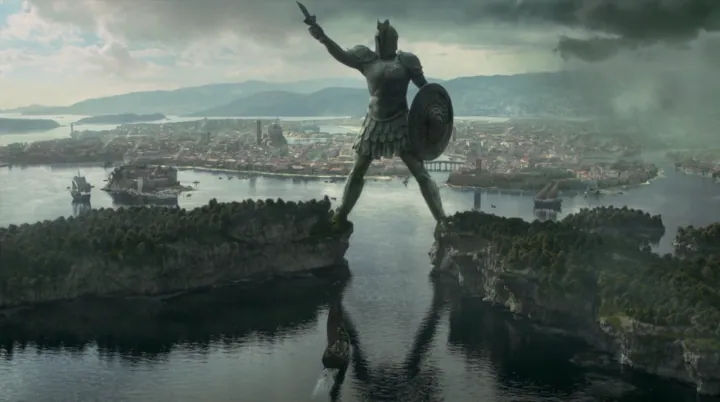
BraavosBraavos HBO.png · hieloyfuego.fandom.com · this wiki publishes under CC-BY-SA
