Seven Kingdoms
los Siete Reinos
The Seven Kingdoms is the name given to the single realm covering nearly the whole continent of Westeros, from the Wall to Dorne, ruled by whoever sits the Iron Throne in King's Landing. The name is a leftover from an older age, before one crown claimed them all: seven lands that were kingdoms in their own right long before they became provinces of the same throne.
It is the stage on which almost everything that happens to any house, lord, or village in Westeros plays out — to understand the Seven Kingdoms is to understand the whole board the throne is played on.
Chapter 1
Before Aegon
2 BCBooks only
Before there was a single crown, the map of Westeros was split among seven fully sovereign kingdoms, each with its own king and its own seat. The North answered to a King in the North of House Stark ruling from Winterfell; the Vale to a King of Mountain and Vale of House Arryn from the Eyrie; the Iron Islands and the river country to a King of the Isles and the Rivers ruling from Harrenhal.
Further south, a King of the Rock of House Lannister ruled from Casterly Rock, a King of the Reach of House Gardener from Highgarden, and a King of the Storm of House Durrandon from Storm's End. Dorne stood apart, ruled not by a king but by a prince of House Nymeros Martell from Sunspear.
Seven crowns, seven courts, no throne to join them.
Chapter 2
The War of Conquest
From 2 BCBooks only
In the year 2 BC Aegon Targaryen landed in Westeros determined to bring the seven kingdoms under a single rule. The campaign that followed, the War of Conquest, brought six of the seven kings to heel one by one, some by the sword and others through pacts and alliances that avoided battle altogether.
With six crowns yielded, Aegon was crowned king of the Seven Kingdoms — though the name did not quite fit yet: Dorne stood apart, the one kingdom of the seven that never bent the knee.
Chapter 3
Dorne, the last crown
Books only
Dorne took nearly two centuries to join. It did not fall to the sword but to marriages that slowly wove House Targaryen and House Nymeros Martell together, until the union reached where Aegon's armies never had.
Only then, with Sunspear inside the realm, could the Seven Kingdoms truly be called seven.
Chapter 4
Nine regions under one throne
300 ACBooks only
With Dorne inside, the realm was divided into nine administrative regions, two more than the seven original kingdoms. The Riverlands split off from what had been the domain of the Iron Islands because they swore to Aegon before the ironborn did, and the Crownlands were carved out around the mouth of the Blackwater as territory belonging to the king alone.
The realm covers nearly the whole continent, save what lies beyond the Wall, and reaches out to islands near the coast as well, such as Tarth. It is a vast, uneven country: the North and the deserts of Dorne are thinly peopled, while the fertile Reach holds far more people.
Of the many villages, castles, and ports scattered across the map, only a handful of settlements are large enough to be called cities, and none comes close to King's Landing, the capital, home to half a million people.
The coin that circulates across all of it is the same everywhere: gold dragons, silver stags, and copper stars, each with a dragon stamped on one face and a king's likeness on the other.
Chapter 5
A patchwork of peoples
Books only
No one in the Seven Kingdoms belongs to a single, unmixed people: centuries of migration have blended different cultures until today they are barely distinguishable, except by the region each one comes from. The First Men, the continent's earliest settlers, remain the majority in the North and still pray to the Old Gods. The Andals arrived later, crossing the sea, and brought with them the Faith of the Seven that now dominates the south.
Something of the Rhoynar lingers in Dorne, where they mixed with the native Dornishmen, and some still honor the Mother Rhoyne. In the Iron Islands the ironborn keep to their own god, the Drowned God, and in pockets of the Mountains of the Moon, clans survive that have barely changed in centuries.
On top of all that are those who have come from farther away, from the Free Cities and the Summer Isles, bringing their own gods with them — among them R'hllor, the Lord of Light, whose following keeps growing.
Chapter 6
Crowns that change hands
300 ACBooks and show
The administrative map of the Seven Kingdoms has not stood still. Between the years following Aegon's coronation and 300 AC, two wars — Robert's Rebellion and the War of the Five Kings — reshuffled a good many of the houses ruling the different regions.
Which house rules a given kingdom today is, in many cases, no longer the one that ruled it right after the conquest.
Gallery
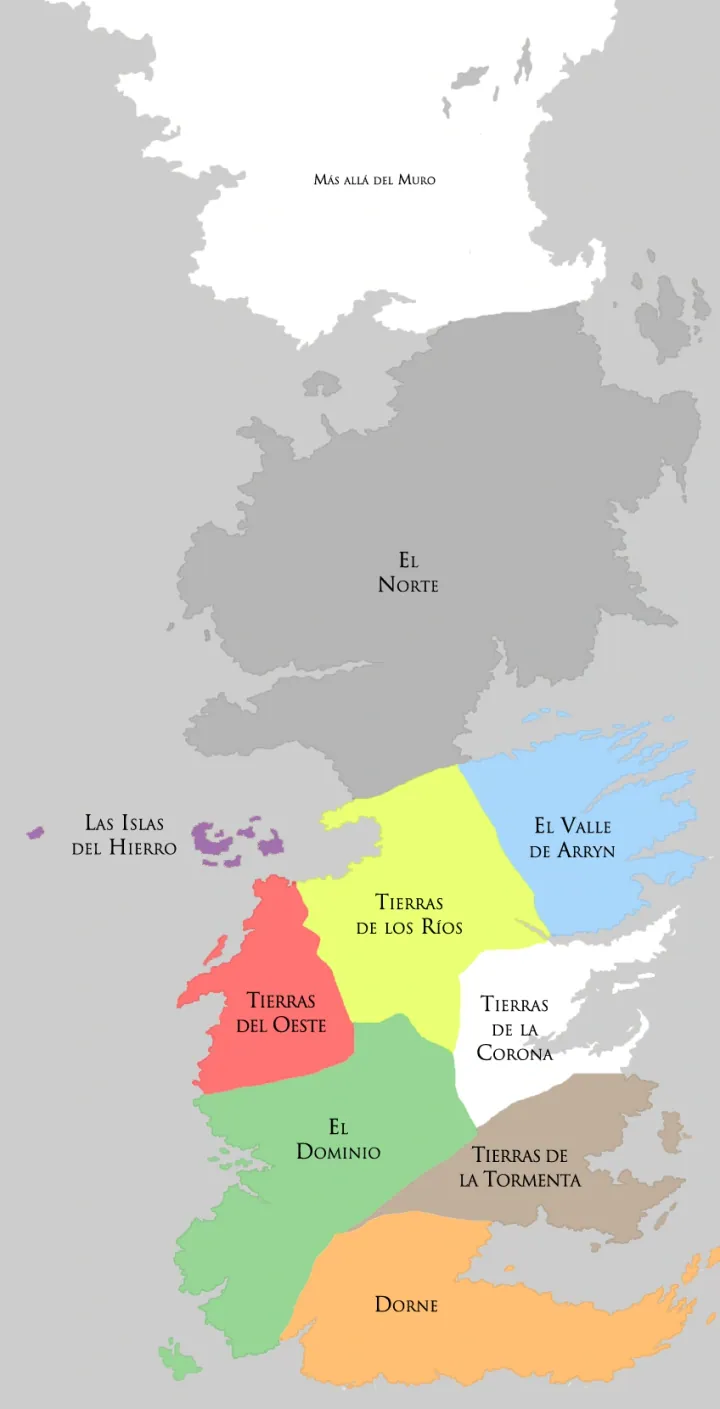
Seven Kingdoms, image 1Siete Reinos post Guerra de la Conquista.png · hieloyfuego.fandom.com · this wiki publishes under CC-BY-SA 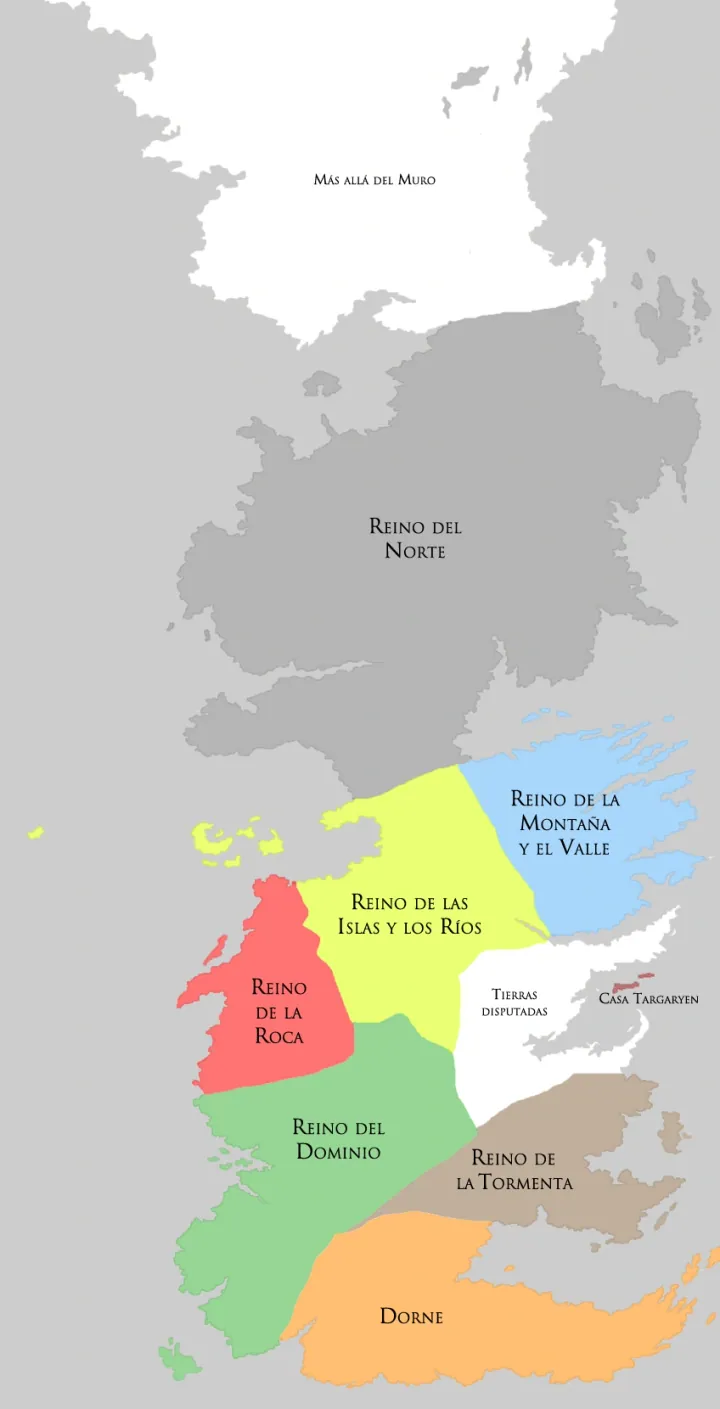
Seven Kingdoms, image 2Siete Reinos pre Guerra de la Conquista.png · hieloyfuego.fandom.com · this wiki publishes under CC-BY-SA


What we are not sure about
PositionWe worked it out
The position was inferred from the label on the base map rather than from a symbol of its own: it marks the area, not the point.