Red Fork
la Forca Roja
Not to be confused with Red Fork (river).
The Red Fork is one of the three great branches of the Trident, in the Riverlands, and lends its color to the Tully sigil itself: its waters run stained with silt from the western mountains. It rises near the Westerlands and flows to Riverrun, the seat raised at its meeting with the Tumblestone.
Surrendered kings, clashing armies, and fugitives bound for Riverrun have all crossed its course: a river that has served, again and again, as the border between the Westerlands and the Riverlands.
Chapter 1
A current that colors the sigil
Books only
 Brynden Tully
The Red Fork rises in the hills near Hornvale and Deep Den, in the Westerlands, and runs northeast past Pinkmaiden Castle before reaching Riverrun, where it joins the Tumblestone. Beyond that junction it flows on toward the Trident, wide and slow, looped with tree-covered islets and sandbars.
Upstream of Riverrun its waters darken and thicken with mud; south of the Inn of the Kneeling Man they widen between muddy, reed-lined banks. Stone Hedge lies south of the river and Raventree Hall to the north, and the lands of House Bracken stretch along its course. Ser Brynden Tully holds that the red of his house's sigil comes from these stained waters.
Chapter 2
The surrender before the dragon
Books only
During the War of Conquest, the King in the North Torrhen Stark surrendered to Aegon the Conqueror on the banks of the Red Fork. Tradition places that meeting where the Inn of the Kneeling Man later stood, its name recalling that king's gesture.
Chapter 3
The battle that stained the river in the Dance
130 ACBooks only
 Jason Lannister
 Aemond Targaryen
During the Dance of the Dragons, Lord Jason Lannister was killed by Pate of Longleaf in the Battle of the Red Fork. That same year, Prince Aemond Targaryen and his dragon Vhagar attacked the village of Sallydance on the river's banks.
Chapter 4
The hunt for the Mountain
Books and show
 Gregor Clegane
 Eddard Stark
 Beric Dondarrion
During the War of the Five Kings, Ser Gregor Clegane attacked Wendish Town, Sherrer, and Mummer's Ford, then withdrew across the Red Fork into the Westerlands before Ser Raymun Darry could cut him off. Lord Eddard Stark sent Lord Beric Dondarrion to capture him, but after crossing the river Beric's men were ambushed by Gregor at Mummer's Ford itself.
Marq Piper and Karyl Vance avenged the defeat by raiding western lands along the Red Fork, and Robb Stark's army later defeated the westermen at the Battle of the Camps; Ser Forley Prester led the survivors south of the river.
Chapter 5
The fords that stopped the Lannisters
Books only
 Catelyn Stark
 Edmure Tully
 Tywin Lannister
Returning from Storm's End, Lady Catelyn Tully crossed the Red Fork at a ford south of Riverrun. Her brother, Ser Edmure Tully, fortified the river against Lord Tywin Lannister's forces, and the rivermen went on to defeat the Lannisters at the Battle of the Fords.
Chapter 6
The river that saw a Tully die and another escape
Books only
 Brienne Tarth
 Jaime Lannister
Brienne of Tarth, Ser Cleos Frey, and Ser Jaime Lannister followed the bank of the Red Fork south of Riverrun to the Inn of the Kneeling Man. Around the same years, Lord Hoster Tully died, and his body was sent downriver on a funeral pyre.
During the siege of Riverrun, Emmon Frey and Forley Prester camped south of the Red Fork while Ser Raynard Ruttiger and Ser Manfryd Yew guarded the castle to keep anyone from escaping. Shortly before its surrender, Ser Brynden Tully swam free beneath one of the Water Gate's portcullises into the river.
The physical world
Corriente arriba de Aguasdulces, el río se curva ampliamente y se hace más oscuro y lodoso.
Route · Choque de Reyes, Capítulo 39, Catelyn.
Sus bancos son de lodo y cañas.
Route · Tormenta de Espadas, Capítulo 11, Jaime.
Seto de Piedra se encuentra al sur del Forca Roja y al este de Aguasdulces, mientras Árbol de los Cuervos se encuentra al norte del río y al sur del Forca Azul. Las tierras de la Casa Bracken se encuentran a lo largo del Forca Roja.
Route · A World of Ice and Fire
Gallery
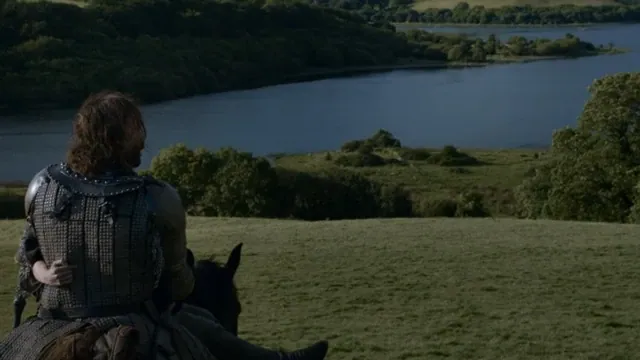
Red ForkForca Roja HBO.jpg · hieloyfuego.fandom.com · this wiki publishes under CC-BY-SA

What we are not sure about
PositionWe worked it out
The position was inferred from the label on the base map rather than from a symbol of its own: it marks the area, not the point.